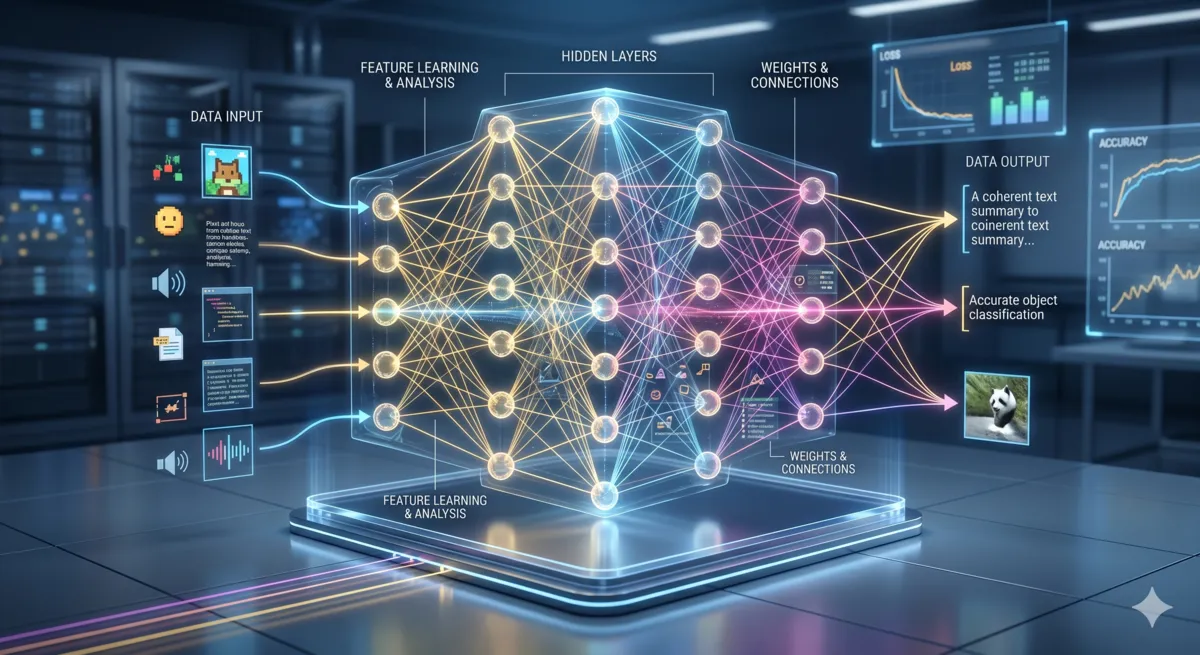
Artificial intelligence is broadly described as the science of building machines that can perform tasks that usually require human-like intelligence.
An artificial intelligence model is a specific machine based system designed to take in information and infer how to generate an output. These outputs can include predictions, content, or decisions that have an impact on the physical or virtual world.
Unlike simple computer programs, a general purpose model can perform a wide variety of different tasks.
-
How AI Models Learn
The foundation of modern models is machine learning, which is a method that allows systems to learn from data without being explicitly programmed for every possible scenario.
Big data: During their development, these models are exposed to massive collections of information often referred to as big data. This data might include text from books, images, or interactions from the internet. By analyzing this data, the model can improve its performance over time through trial and error rather than following fixed logical rules.
-
The Internal Process
Many models are built using artificial neural networks, which are mathematical structures inspired by the way biological neurons work in a human brain. These networks transform information like images or words into embeddings.
Embeddings: Embeddings are essentially long lists of numbers that represent the unique features and characteristics of that piece of data. To identify an object or understand a concept, the model uses a distance metric to calculate the mathematical space between these lists of numbers. If the numbers are mathematically close together, the system concludes that the items are similar.
-
Advanced Capabilities and Interaction
Modern systems often use an attention mechanism to produce better results. This is a technique that mimics human selective focus, allowing the model to emphasize the most relevant parts of the input data while ignoring less important details.
Tool calling: Furthermore, some systems function as autonomous agents, which are models capable of acting on their own to complete complex goals. These agents can use tool calling to connect to external services and find up to date information that they did not have when they were first trained.
By planning workflows and creating smaller subtasks, these models can solve problems and adapt to user expectations over time.